



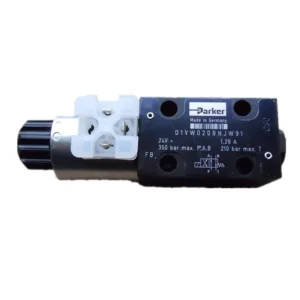

Product Overview
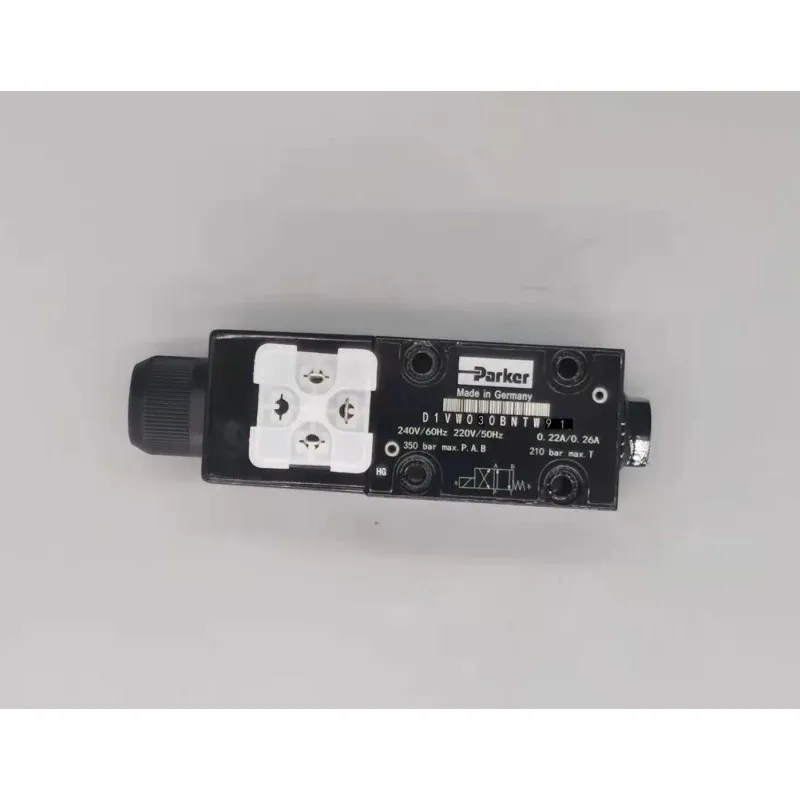
The Parker D1VW030BNTW is a direct-operated solenoid directional spool valve from the Parker D1VW family.
The D1VW platform is designed for NG06 / CETOP 03 / NFPA D03 hydraulic systems and provides direct electromagnetic flow-direction control with optimized internal passages for relatively high flow capability and low pressure loss. Parker also offers multiple spool configurations, manual overrides and soft-shift options across the series.
The exact model D1VW030BNTW is identified in Parker-related product records with:
- 030 spool
- 2-position operation
- spring offset in position b
- solenoid operation in position a
- NBR seals
- 230/240 VAC, 50/60 Hz electrical configuration.
Historical Parker cross-reference material also lists D1VW030BNTW directly, confirming it as an established D1VW ordering configuration.
Technical Specifications
D1VW030BNTW
- Model: D1VW030BNTW
- Manufacturer: Parker Hannifin
- Series: D1VW
- Product Type: Direct-operated solenoid directional spool valve
- Actuation: Direct electromagnetic actuation
- Nominal Size: DIN NG06
- Interface: CETOP 03 / NFPA D03
- Mounting Standard: DIN 24340 A6 / ISO 4401 / CETOP RP 121-H / NFPA D03
- Mounting: Subplate mounting
- Spool Code: 030
- Spool Position: 2 positions
- Spring Offset: Position “b”
- Energized Position: Position “a”
- Solenoid Configuration: Single solenoid
- Input Voltage: 230/240 VAC
- Frequency: 50/60 Hz
- Seal Material: NBR
- Maximum Operating Pressure at P/A/B: 350 bar
- Maximum T-Port Pressure: 140 bar for the AC configuration
- Maximum Series Flow: Up to 80 L/min, subject to spool-specific shift limits.
- Hydraulic Fluid: Hydraulic oil according to DIN 51524
- Permitted Viscosity: 2.8–400 cSt
- Recommended Viscosity: 30–80 cSt
- Ambient Temperature: -25 to +60 °C depending on seal configuration.
- Fluid Cleanliness: ISO 4406 Class 18/16/13.
- Recommended Mounting Position: Any position, preferably horizontal
- Body Material: Cast iron
- Electrical Connection: EN 175301-803
- Maximum Switching Frequency, AC: 7,200 operations/hour
- Duty Cycle: 100% ED
- Leakage at 50 bar: Up to approximately 10 ml/min per flow path, depending on spool
- 95% Energized Response: Approximately 40 ms for AC
- 95% De-energized Response: Approximately 75 ms for AC.
- Weight: No independently verified Parker current single-part weight is stated for the exact D1VW030BNTW configuration
- Displacement: Not applicable
- Maximum Speed: Not applicable
- Peak Pressure: No separate peak-pressure rating is specified; selection should use the 350 bar P/A/B and 140 bar T-port operating limits.
Key Technical Advantages
1. Direct-operated directional control
The D1VW uses direct electromagnetic actuation of the hydraulic spool without a separate hydraulic pilot stage.
This gives the NG06 valve a compact architecture and a direct control path suitable for industrial hydraulic directional switching. Parker explicitly identifies the D1VW as a direct-operated solenoid directional control valve.
2. 350 bar P/A/B pressure capability
The D1VW platform supports up to 350 bar at P, A and B, providing a high-pressure capability suitable for demanding industrial hydraulic circuits.
However, the AC configuration has a lower 140 bar T-port limit, which must be considered independently.
3. Defined 030 spool logic
The exact D1VW030BNTW configuration uses a 2-position spool, spring-offset to position b, and electrically operated toward position a.
This makes the complete spool configuration critical when selecting a replacement.
4. Optimized internal flow passages
Parker specifies optimized flow passages to combine high functional limits with low, energy-saving pressure drop.
Reducing unnecessary valve pressure drop can reduce hydraulic power losses and thermal loading in high-cycle equipment.
5. Up to 80 L/min family flow capability
The D1VW family is specified for up to 80 L/min, but Parker requires the appropriate spool shift limits to be considered.
The 80 L/min figure should therefore not be treated as an unconditional flow guarantee for every spool and pressure condition.
6. 230/240 VAC industrial coil
The exact D1VW030BNTW model is associated with a 230/240 VAC, 50/60 Hz solenoid configuration.
This is suitable for industrial control systems using AC solenoid outputs but is not directly interchangeable with 12 or 24 VDC versions without electrical verification.
7. Wet-pin solenoid and optional soft shifting
The D1VW architecture uses a wet-pin solenoid and supports optional soft-shift configurations for smoother spool movement.
Parker documents the use of an additional orifice at the solenoid anchor to increase shifting time and reduce hydraulic switching impact.
8. Cast-iron valve body
Parker’s D1VW product information identifies cast iron as the body material.
From a manufacturing perspective, long-term sealing and spool reliability still depend heavily on spool-to-bore clearance, concentricity, mounting-surface accuracy and internal flow geometry.
9. Standard CETOP 03 mounting for OEM replacement
The NG06 / CETOP 03 / NFPA D03 interface provides a standardized installation platform for existing manifolds and subplates.
Our replacement engineering can target true Parker D1VW interchangeability by matching:
- mounting interface
- 030 spool function
- AC coil configuration
- P/A/B/T pressure limits
- actual flow requirement
- electrical connection
Each replacement unit can then be validated through 100% simulated operating-condition testing.
Application Areas
Typical applications include:
- Hydraulic power units
- Machine tools
- Hydraulic presses
- Injection-molding auxiliary circuits
- Hydraulic clamping systems
- Automated hydraulic actuators
- Material-handling systems
- Industrial lifting equipment
- Metal-forming machinery
- OEM hydraulic manifolds
- Legacy Parker hydraulic equipment
- Industrial hydraulic control panels
The D1VW030BNTW is particularly suitable where a standard NG06/CETOP 03 valve must operate from a 230/240 VAC control system.
Expert Maintenance Tips
1. Confirm the 030 spool
Do not purchase a replacement using only the generic term D1VW.
The 030 spool code must be retained because spool geometry defines the hydraulic connection logic. Parker’s ordering information treats spool code as a core configuration parameter.
2. Verify the B-position spring offset
The D1VW030 configuration is:
Spring offset → position b
Solenoid energized → position a
The machine’s actual actuator behavior should be checked against the original hydraulic schematic during commissioning.
3. Confirm 230/240 VAC power
The exact model uses 230/240 VAC, 50/60 Hz.
Verify:
- supply voltage
- AC/DC type
- frequency
- coil identification
- connector condition
before applying power.
4. Monitor T-port back pressure
The P/A/B maximum pressure is 350 bar, while the AC T-port limit is only 140 bar.
This is particularly important when several directional valves share a common return line.
5. Size flow using the spool shift limit
Although the D1VW family can reach 80 L/min, Parker specifies that actual shift limits depend on spool configuration and flow balance. Under unbalanced flow conditions, the permissible flow can be significantly lower. A P-port plug-in orifice may be used to restrict excessive flow where required.
6. Maintain hydraulic cleanliness
The specified contamination level is ISO 4406 Class 18/16/13.
Contamination can cause:
- spool sticking
- delayed switching
- increased leakage
- unstable switching behavior
- abnormal pressure drop
7. Inspect the mounting surface and O-rings
During replacement, inspect:
- mounting surface
- O-rings
- mounting holes
- manifold flatness
- port cleanliness
- fastening condition
Parker’s installation documentation gives a reference fastening arrangement of 4 × M5 × 30, ISO 4762-12.9, 7.6 Nm ±15%.
8. Check AC coil temperature correctly
AC solenoid heating should be evaluated together with:
- supply voltage
- current
- switching frequency
- ambient temperature
- connector condition
Coil temperature alone is not sufficient evidence of electrical failure.
9. Perform complete dynamic validation
After replacement, recommended testing includes:
- 230/240 VAC electrical verification
- spool-position verification
- energized/de-energized directional testing
- P/A/B/T pressure measurement
- flow measurement
- T-line back-pressure measurement
- pressure-drop evaluation
- repeated switching
- thermal stabilization
- continuous cycling
Our OEM replacement products can undergo 100% simulated operating-condition testing to verify mechanical fit, electrical compatibility, spool function and hydraulic performance before shipment.