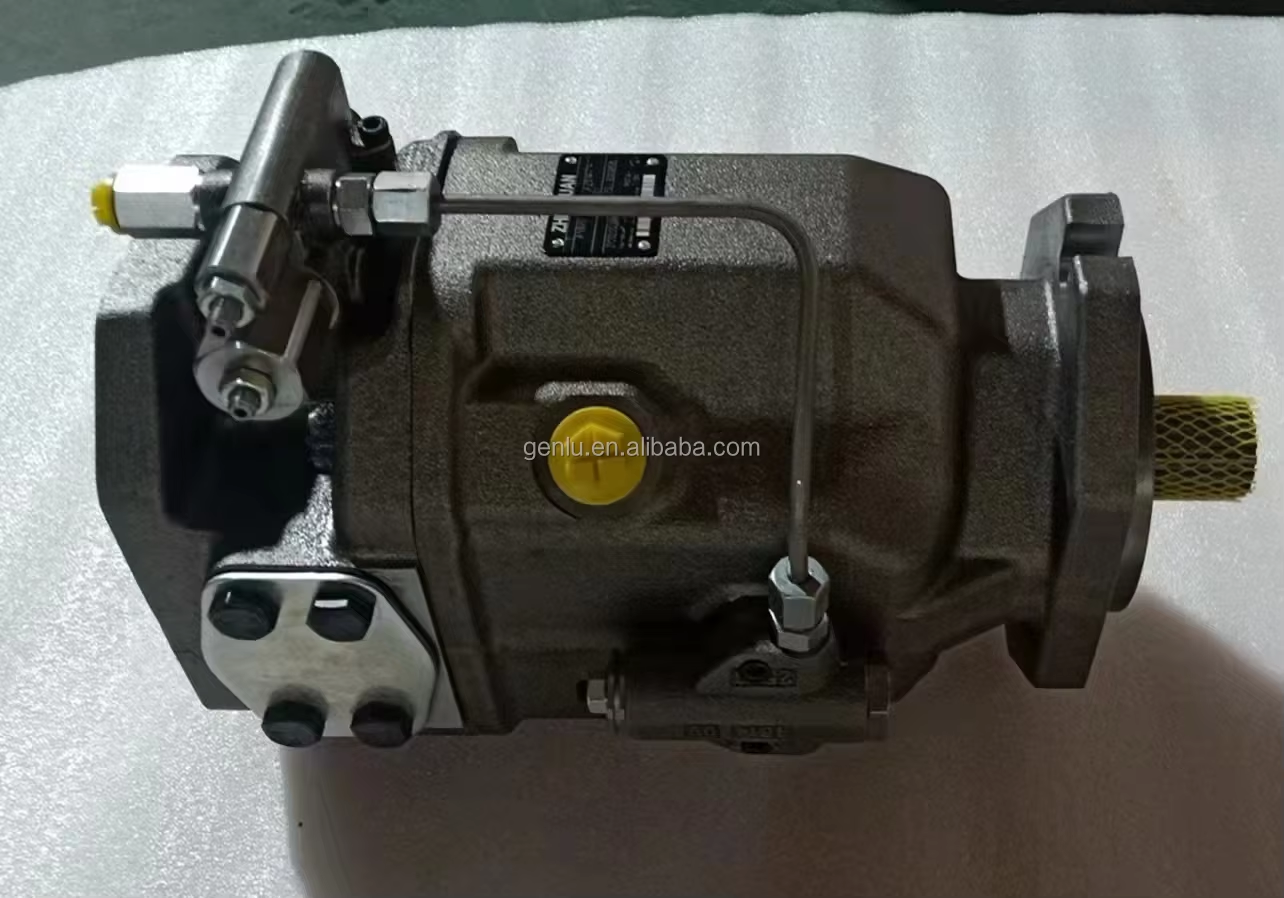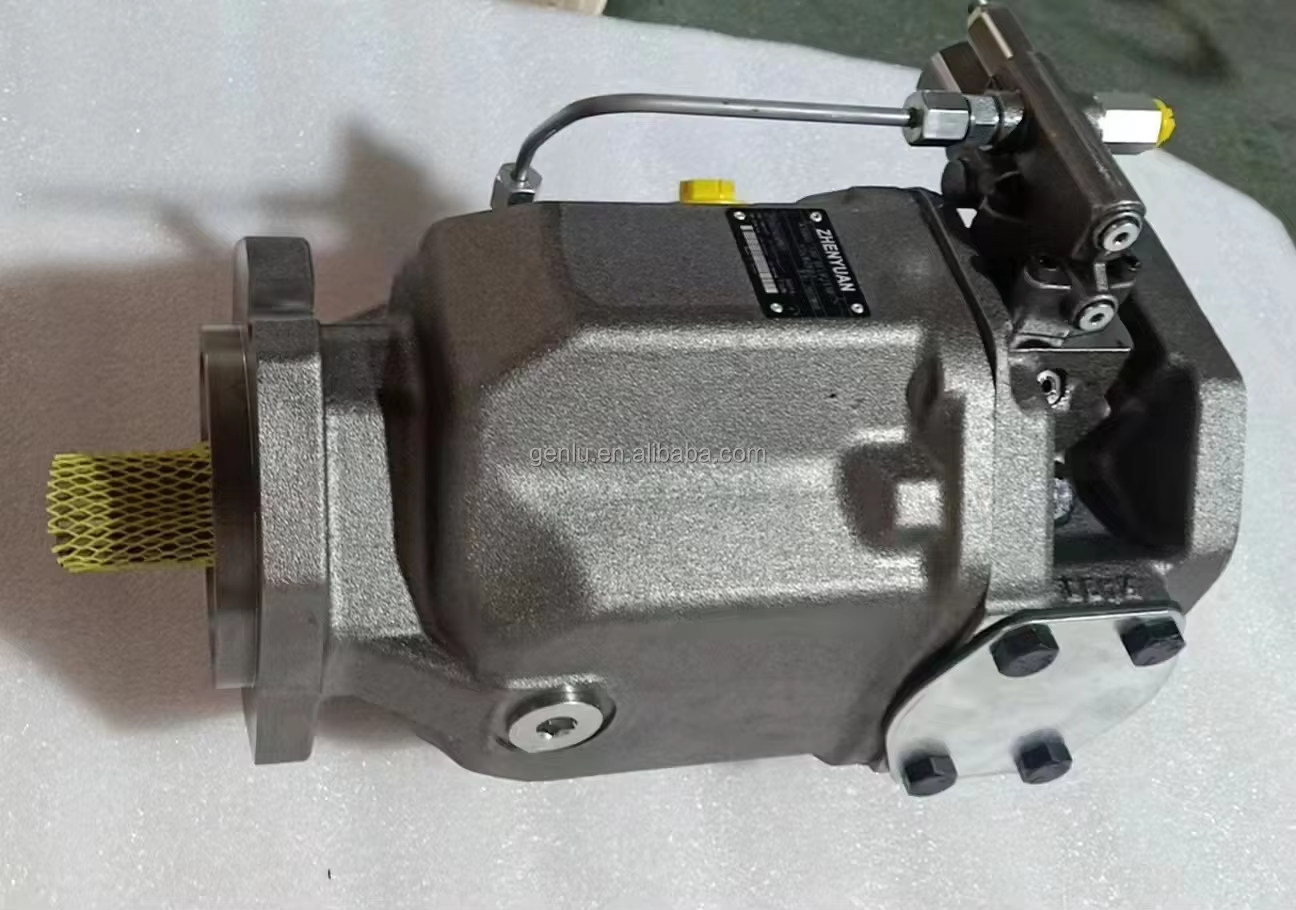
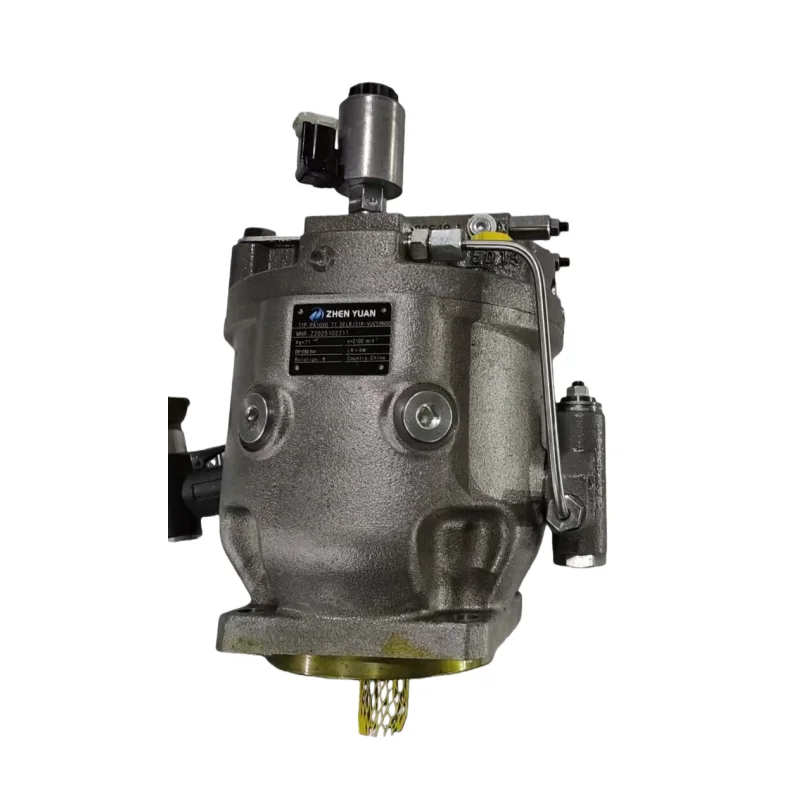
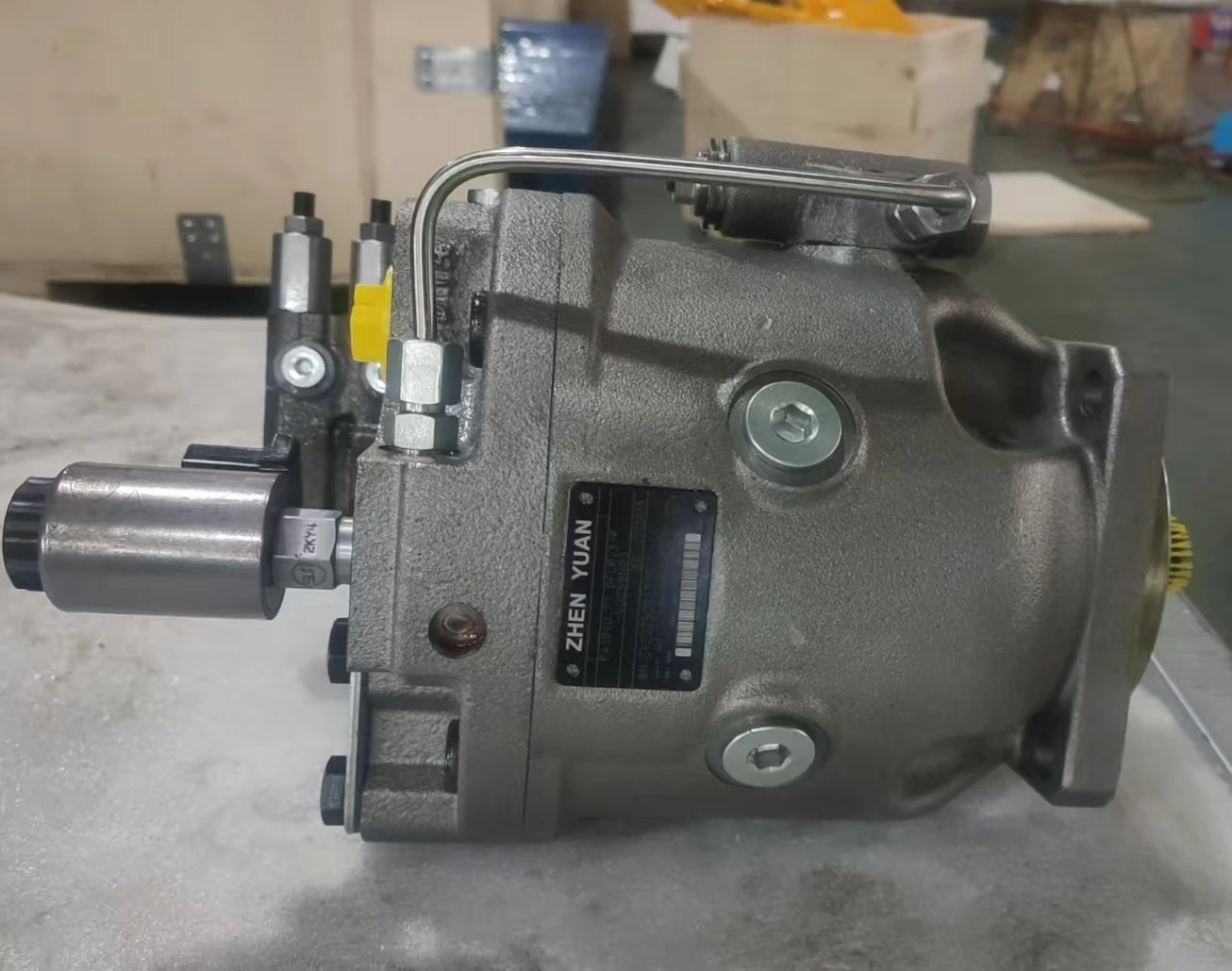
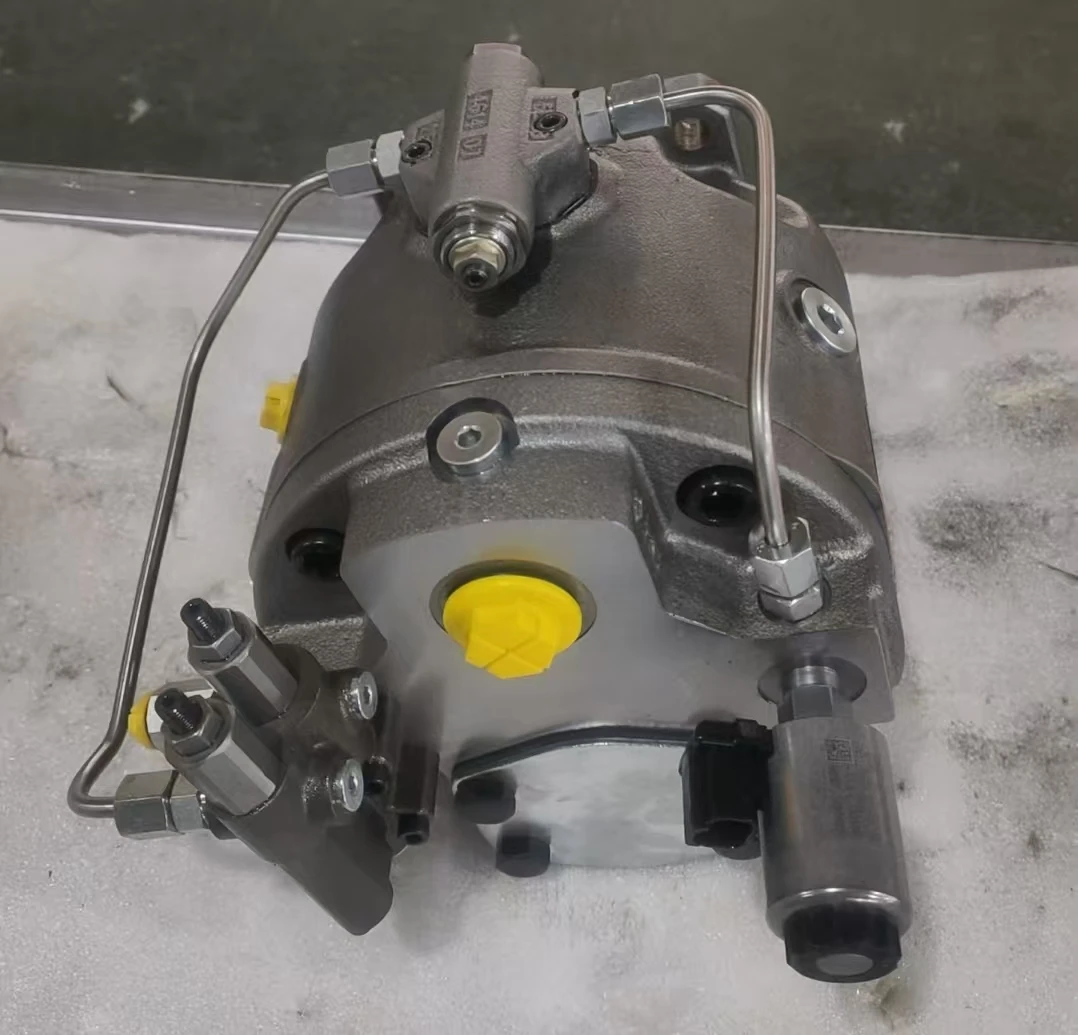
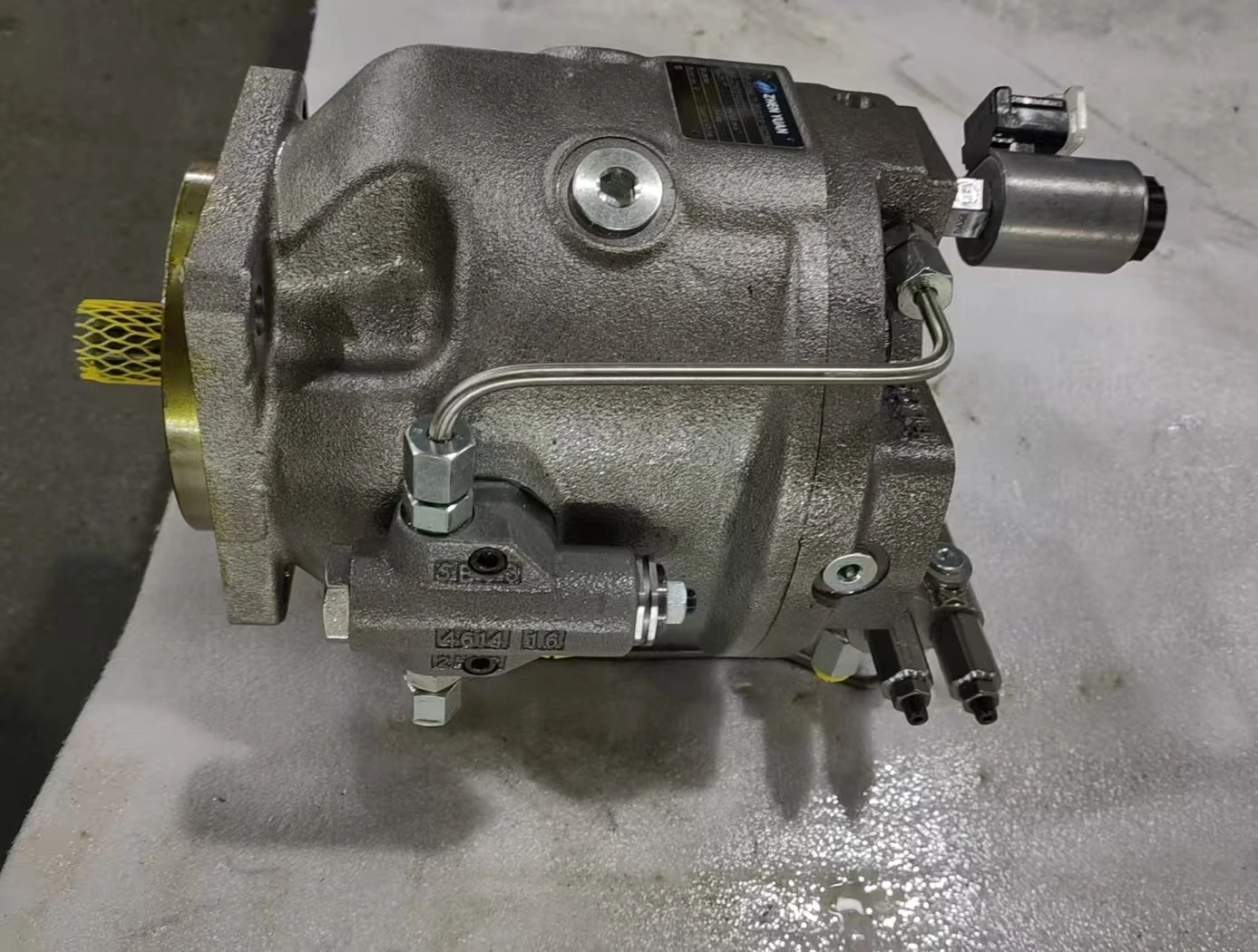
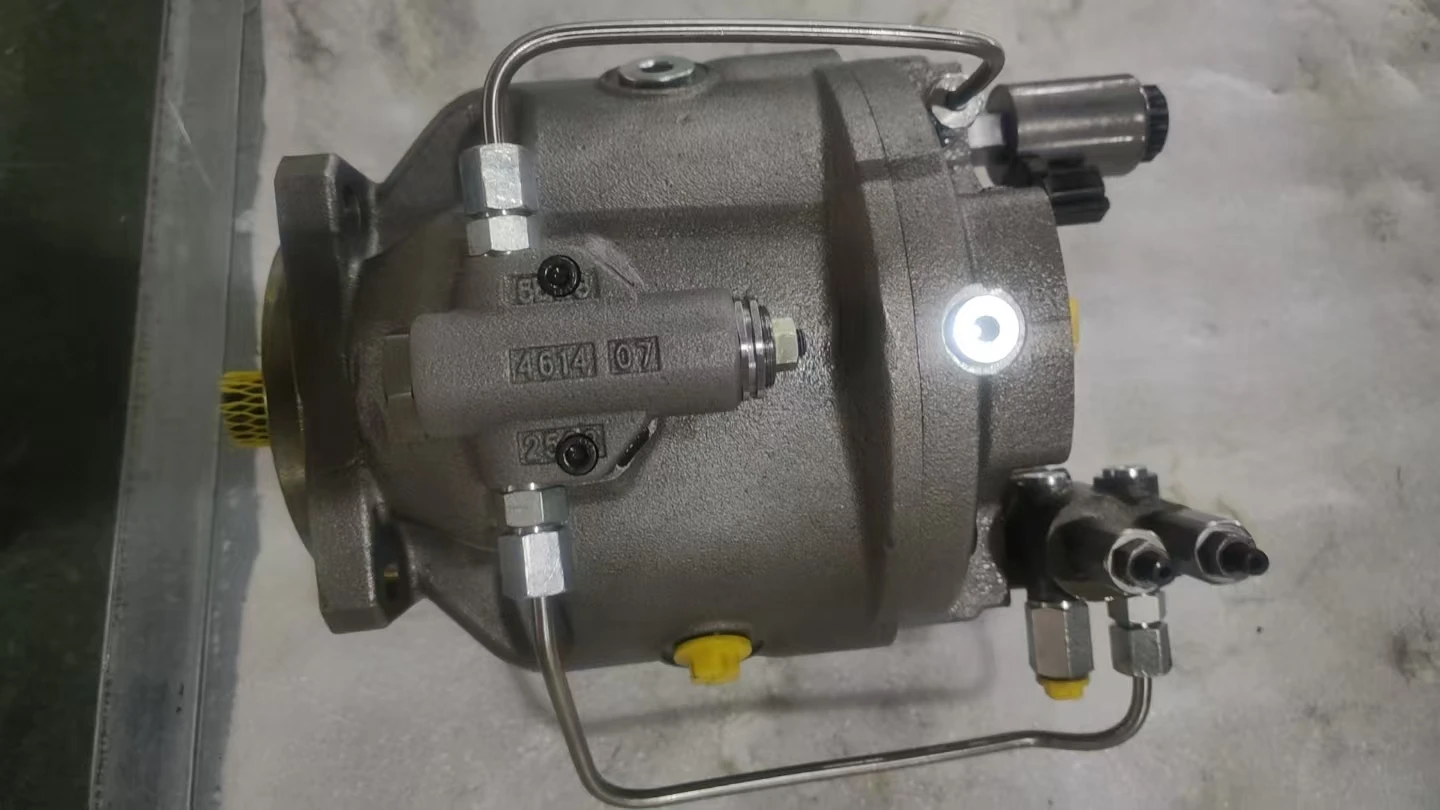
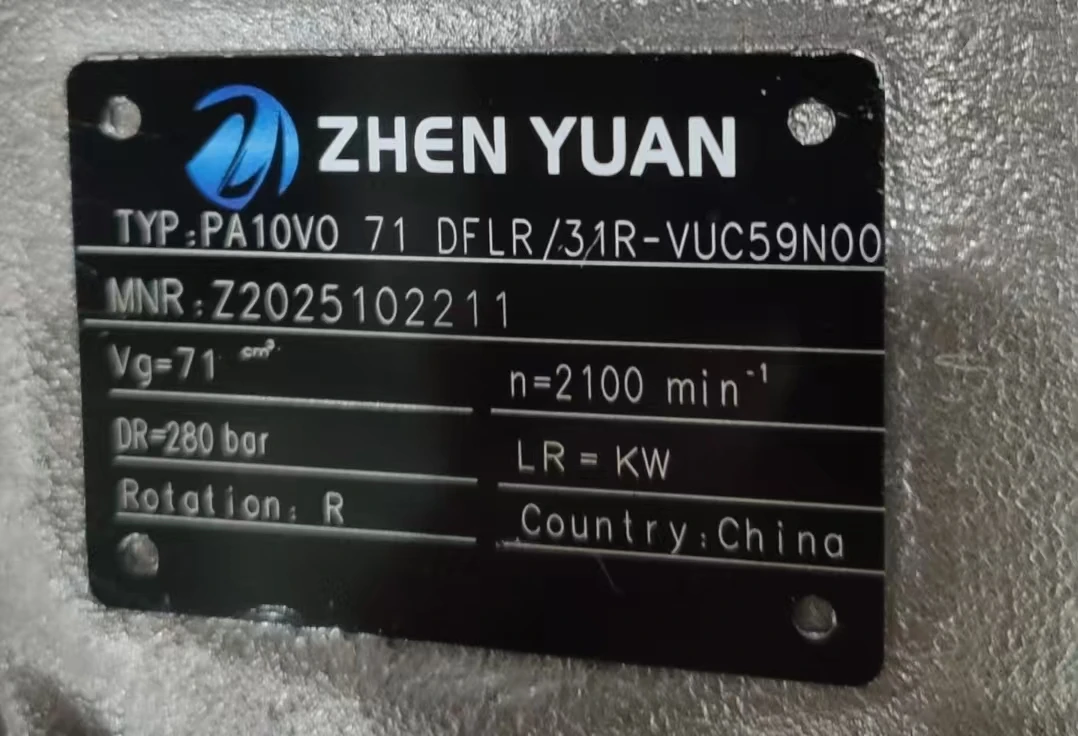
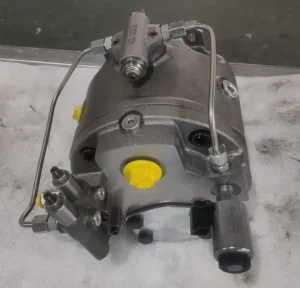
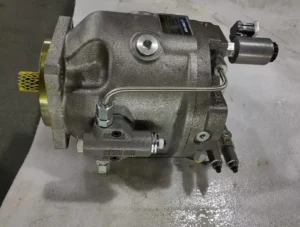
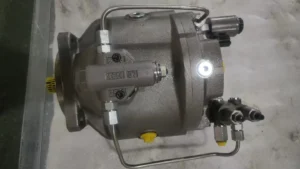
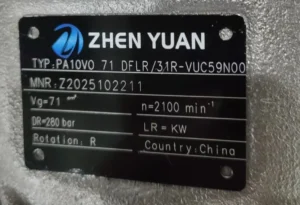
PA10VO71DFLR/31R-VUC59N00 Swash Plate Axial Piston Fixed Displacement Pump A10VO A10VSO18/28/45/71/100/140 Hydraulic Oil Pump
I. Technical Parameters
1.
Displacement and pressure
Theoretical displacement: 71 mL/r (milliliters per revolution), belonging to the medium displacement specification, providing a high-pressure and precise power source for medium and heavy-duty hydraulic actuators
2.
Rated pressure: 31.5 MPa (315 bar), capable of withstanding long-term cyclic heavy-load operations, suitable for high-intensity working conditions of medium-sized equipment. Instantaneous peak pressure: 35 MPa (350 bar), single duration ≤10 seconds, capable of handling extreme conditions such as start-up shock and sudden load changes
3.
Rotational speed range
Rated speed: 1500-2500 rpm, with excellent matching performance with the commonly used output speeds of medium-sized construction machinery engines and industrial motors
4.
Maximum allowable speed: 3000 rpm, minimum stable speed ≤80 rpm (without cavitation or pressure fluctuation), pressure stability error under low-speed conditions ≤1.5%
5.
Structural form: Axial piston variable pump (marked with “DFLR” for constant power + load sensitive composite variable structure); The plunger is made of nitrided alloy steel (surface hardness HV900-1000), the cylinder body is high-strength forged aluminum alloy, and the oil distribution plate is copper-based wear-resistant alloy. “VUC59N00” corresponds to high-pressure stage + double-lip skeleton oil seal + integrated pressure compensation valve
6.
Oil requirements
Applicable oil type: L-HM 46 or 68 anti-wear hydraulic oil is recommended. For cold regions (below -30℃), L-HV 68 low-temperature anti-wear hydraulic oil should be selected, with a viscosity range of 15-400 mm²/s
7.
Working oil temperature: -30℃ to 90℃. The oil cleanliness should reach ISO 16/13 grade (NAS 7 grade). A 10μm high-pressure filter is installed at the oil inlet, and a 20μm fine filter is added at the oil return port
8.
Installation and adaptation
Installation type: SAE C3 flange installation, shaft end with Φ45mm flat key connection, keyway specification 14× 9mm, positioning pin diameter Φ8mm, shell sealing adopts fluororubber O-ring
9.
Oil port specifications: Suction port G2.5, pressure port G2, supports unidirectional rotating oil supply, overall weight approximately 32kg, recommended horizontal installation (inclined installation Angle ≤15°)
10.
Other parameters Volumetric efficiency ≥95% (rated condition), total efficiency ≥91%, no-load noise value ≤83 dB (2000 rpm), shaft end radial runout ≤0.1 mm, constant power variable adjustment range 10%-100% displacement, load sensitive response time ≤50ms, working life ≥ 12,000 hours (rated condition) Internal leakage ≤0.6 L/min (at 31.5MPa)Ii. Working Principle
This pump is an axial plunger variable hydraulic pump. Its core components include a plunger, cylinder block, oil distribution plate, swash plate, transmission shaft, constant power – load sensitive composite variable mechanism and sealing assembly. It achieves oil suction and pressure by changing the volume of the sealed cavity through the reciprocating motion of the plunger in the cylinder block. The variable characteristics are precisely controlled by adjusting the inclination Angle of the swash plate through the composite variable mechanism. The specific process is as follows:
1.
Power transmission and cylinder block rotation: The power source (engine, motor) drives the transmission shaft to rotate through a coupling. The transmission shaft drives the cylinder block to rotate synchronously. Under the action of centrifugal force and return spring, the ball heads of the evenly distributed plungers in the cylinder block always closely adhere to the working surface of the swash plate, forming a stable force transmission structure and laying the foundation for reciprocating motion
2.
Plunger reciprocation and suction oil circulation: Due to the adjustable inclination Angle of the swash plate, when the cylinder block rotates, the plunger rotates along with the cylinder block around the axis of the transmission shaft, and at the same time, it moves back and forth in a straight line along the cylinder block hole under the push of the inclined surface of the swash plate. When the plunger moves from the lower position to the higher position of the swash plate, it extends out of the cylinder body. The volume of the sealed cavity increases to form a vacuum, and the oil is sucked through the oil suction window of the oil distribution plate. When moving from a high position to a low one, the cylinder retracts, the cavity volume shrinks, and the oil is squeezed and output to the system through the oil pressure window
3.
Compound variable regulation mechanism: The integrated constant power and load sensitive mechanism work in coordination: The constant power mechanism monitors the system pressure. When the pressure rises to 25MPa, it pushes the swash plate to reduce the tilt Angle and lower the displacement to maintain power stability. The load-sensitive mechanism collects the load pressure of the actuator in real time. When the load decreases, it quickly increases the swash plate Angle through pressure feedback to increase the displacement and meet the flow demand, achieving “on-demand fuel supply”. Compared with a single-variable mechanism, it saves 20% to 25% of energy
4.
Pressure compensation and stable output: The built-in pressure compensation valve balances the intake oil pressure and system pressure in real time. When the load suddenly changes and causes pressure fluctuations, the compensation valve quickly adjusts the opening degree of the valve core to stabilize the rate of change in the swash plate Angle and avoid system shock caused by sudden changes in displacement. The oil distribution plate adopts a hydrodynamic lubrication design to ensure a continuous and interfer-free oil suction process and enhance output stabilityIii. Product Features and Advantages
1.
The medium displacement compound variable adjustment is precise The 71mL/r basic displacement is suitable for medium-sized hydraulic systems. With a wide range of variable adjustment from 10% to 100% and load-sensitive control, it can dynamically adjust the flow rate in real time according to the load (the flow rate at 2000rpm changes steplessly from 7.1 to 71L /min), saving more than 20% energy compared to traditional constant power pumps. Adapt to the coordinated operation of multiple actuating elements (such as the compound action of excavator bucket digging and rotating)
2.
Outstanding high-pressure wear resistance and reliability: The plunger is made of nitrided alloy steel with a surface hardness of HV900-1000. Combined with the fluid dynamic pressure lubrication technology of copper-based oil distribution plates, its working life at a rated pressure of 31.5MPa exceeds 12,000 hours, which is 30% longer than that of ordinary plunger pumps. The fit clearance between the cylinder block and the plunger is controlled within 0.005-0.01mm, the volumetric efficiency is ≥95%, and the energy loss during long-term operation is low
3.
Excellent impact resistance and dynamic response
The compound variable mechanism and pressure compensation valve work in synergy, ensuring stable operation at a peak pressure of 35MPa. When the load fluctuates, the pressure error is ≤1.5%, and the shock resistance is 50% higher than that of a single variable pump. The combination of double-lip skeleton oil seal and fluororubber seal has a shaft end leakage of no more than 5 drops per minute, which is suitable for high-pressure sealing requirements
4.
The load-sensitive response time is ≤50ms. It only takes 0.3 seconds to switch from low speed and small flow to high speed and large flow, which is 40% faster than the response speed of traditional pumps. The forged aluminum alloy cylinder block has excellent heat dissipation performance and can operate continuously at 90℃ for 48 hours without overheating
5.
Strong integration and adaptability: It integrates four major functions: constant power variable, load sensitivity, pressure compensation, and safe unloading. Its volume is 40% smaller than that of the split solution, and there is no need to install additional complex valve groups. SAE C3 standardized flange installation, shaft end connection dimensions compatible with pumps of the same specification, can directly replace old equipment, and the modification cost is reduced by 50%
6.
Wide working condition compatibility range: 15-400mm²/s wide viscosity suitable for different regional climates, -30℃ to 90℃ oil temperature covering cold and tropical regions for operation. With a speed range of 80 to 3000rpm and a power source of 100 to 200 horsepower, it is suitable for various working conditions ranging from low-speed precise fine-tuning (such as hydraulic fixture clamping) to high-speed heavy-load (such as loader lifting)
1.
Displacement and pressure
Theoretical displacement: 71 mL/r (milliliters per revolution), belonging to the medium displacement specification, providing a high-pressure and precise power source for medium and heavy-duty hydraulic actuators
2.
Rated pressure: 31.5 MPa (315 bar), capable of withstanding long-term cyclic heavy-load operations, suitable for high-intensity working conditions of medium-sized equipment. Instantaneous peak pressure: 35 MPa (350 bar), single duration ≤10 seconds, capable of handling extreme conditions such as start-up shock and sudden load changes
3.
Rotational speed range
Rated speed: 1500-2500 rpm, with excellent matching performance with the commonly used output speeds of medium-sized construction machinery engines and industrial motors
4.
Maximum allowable speed: 3000 rpm, minimum stable speed ≤80 rpm (without cavitation or pressure fluctuation), pressure stability error under low-speed conditions ≤1.5%
5.
Structural form: Axial piston variable pump (marked with “DFLR” for constant power + load sensitive composite variable structure); The plunger is made of nitrided alloy steel (surface hardness HV900-1000), the cylinder body is high-strength forged aluminum alloy, and the oil distribution plate is copper-based wear-resistant alloy. “VUC59N00” corresponds to high-pressure stage + double-lip skeleton oil seal + integrated pressure compensation valve
6.
Oil requirements
Applicable oil type: L-HM 46 or 68 anti-wear hydraulic oil is recommended. For cold regions (below -30℃), L-HV 68 low-temperature anti-wear hydraulic oil should be selected, with a viscosity range of 15-400 mm²/s
7.
Working oil temperature: -30℃ to 90℃. The oil cleanliness should reach ISO 16/13 grade (NAS 7 grade). A 10μm high-pressure filter is installed at the oil inlet, and a 20μm fine filter is added at the oil return port
8.
Installation and adaptation
Installation type: SAE C3 flange installation, shaft end with Φ45mm flat key connection, keyway specification 14× 9mm, positioning pin diameter Φ8mm, shell sealing adopts fluororubber O-ring
9.
Oil port specifications: Suction port G2.5, pressure port G2, supports unidirectional rotating oil supply, overall weight approximately 32kg, recommended horizontal installation (inclined installation Angle ≤15°)
10.
Other parameters Volumetric efficiency ≥95% (rated condition), total efficiency ≥91%, no-load noise value ≤83 dB (2000 rpm), shaft end radial runout ≤0.1 mm, constant power variable adjustment range 10%-100% displacement, load sensitive response time ≤50ms, working life ≥ 12,000 hours (rated condition) Internal leakage ≤0.6 L/min (at 31.5MPa)Ii. Working Principle
This pump is an axial plunger variable hydraulic pump. Its core components include a plunger, cylinder block, oil distribution plate, swash plate, transmission shaft, constant power – load sensitive composite variable mechanism and sealing assembly. It achieves oil suction and pressure by changing the volume of the sealed cavity through the reciprocating motion of the plunger in the cylinder block. The variable characteristics are precisely controlled by adjusting the inclination Angle of the swash plate through the composite variable mechanism. The specific process is as follows:
1.
Power transmission and cylinder block rotation: The power source (engine, motor) drives the transmission shaft to rotate through a coupling. The transmission shaft drives the cylinder block to rotate synchronously. Under the action of centrifugal force and return spring, the ball heads of the evenly distributed plungers in the cylinder block always closely adhere to the working surface of the swash plate, forming a stable force transmission structure and laying the foundation for reciprocating motion
2.
Plunger reciprocation and suction oil circulation: Due to the adjustable inclination Angle of the swash plate, when the cylinder block rotates, the plunger rotates along with the cylinder block around the axis of the transmission shaft, and at the same time, it moves back and forth in a straight line along the cylinder block hole under the push of the inclined surface of the swash plate. When the plunger moves from the lower position to the higher position of the swash plate, it extends out of the cylinder body. The volume of the sealed cavity increases to form a vacuum, and the oil is sucked through the oil suction window of the oil distribution plate. When moving from a high position to a low one, the cylinder retracts, the cavity volume shrinks, and the oil is squeezed and output to the system through the oil pressure window
3.
Compound variable regulation mechanism: The integrated constant power and load sensitive mechanism work in coordination: The constant power mechanism monitors the system pressure. When the pressure rises to 25MPa, it pushes the swash plate to reduce the tilt Angle and lower the displacement to maintain power stability. The load-sensitive mechanism collects the load pressure of the actuator in real time. When the load decreases, it quickly increases the swash plate Angle through pressure feedback to increase the displacement and meet the flow demand, achieving “on-demand fuel supply”. Compared with a single-variable mechanism, it saves 20% to 25% of energy
4.
Pressure compensation and stable output: The built-in pressure compensation valve balances the intake oil pressure and system pressure in real time. When the load suddenly changes and causes pressure fluctuations, the compensation valve quickly adjusts the opening degree of the valve core to stabilize the rate of change in the swash plate Angle and avoid system shock caused by sudden changes in displacement. The oil distribution plate adopts a hydrodynamic lubrication design to ensure a continuous and interfer-free oil suction process and enhance output stabilityIii. Product Features and Advantages
1.
The medium displacement compound variable adjustment is precise The 71mL/r basic displacement is suitable for medium-sized hydraulic systems. With a wide range of variable adjustment from 10% to 100% and load-sensitive control, it can dynamically adjust the flow rate in real time according to the load (the flow rate at 2000rpm changes steplessly from 7.1 to 71L /min), saving more than 20% energy compared to traditional constant power pumps. Adapt to the coordinated operation of multiple actuating elements (such as the compound action of excavator bucket digging and rotating)
2.
Outstanding high-pressure wear resistance and reliability: The plunger is made of nitrided alloy steel with a surface hardness of HV900-1000. Combined with the fluid dynamic pressure lubrication technology of copper-based oil distribution plates, its working life at a rated pressure of 31.5MPa exceeds 12,000 hours, which is 30% longer than that of ordinary plunger pumps. The fit clearance between the cylinder block and the plunger is controlled within 0.005-0.01mm, the volumetric efficiency is ≥95%, and the energy loss during long-term operation is low
3.
Excellent impact resistance and dynamic response
The compound variable mechanism and pressure compensation valve work in synergy, ensuring stable operation at a peak pressure of 35MPa. When the load fluctuates, the pressure error is ≤1.5%, and the shock resistance is 50% higher than that of a single variable pump. The combination of double-lip skeleton oil seal and fluororubber seal has a shaft end leakage of no more than 5 drops per minute, which is suitable for high-pressure sealing requirements
4.
The load-sensitive response time is ≤50ms. It only takes 0.3 seconds to switch from low speed and small flow to high speed and large flow, which is 40% faster than the response speed of traditional pumps. The forged aluminum alloy cylinder block has excellent heat dissipation performance and can operate continuously at 90℃ for 48 hours without overheating
5.
Strong integration and adaptability: It integrates four major functions: constant power variable, load sensitivity, pressure compensation, and safe unloading. Its volume is 40% smaller than that of the split solution, and there is no need to install additional complex valve groups. SAE C3 standardized flange installation, shaft end connection dimensions compatible with pumps of the same specification, can directly replace old equipment, and the modification cost is reduced by 50%
6.
Wide working condition compatibility range: 15-400mm²/s wide viscosity suitable for different regional climates, -30℃ to 90℃ oil temperature covering cold and tropical regions for operation. With a speed range of 80 to 3000rpm and a power source of 100 to 200 horsepower, it is suitable for various working conditions ranging from low-speed precise fine-tuning (such as hydraulic fixture clamping) to high-speed heavy-load (such as loader lifting)
Iv. Usage Functions and Purposes
1. Usage function
•
As the core power source of medium-sized hydraulic systems, it outputs 31.5MPa high-pressure oil at a speed of 1500-2500 RPM, driving the actuating elements to perform heavy-load actions such as lifting, digging, and pressing. The compound variable regulation supports multi-action coordination (such as the combined operation of crane luffing and telescopic).
•
Energy-saving and precise control: Load sensitivity + constant power compound regulation, pressure and flow are matched as needed, reducing fuel consumption by 20%-25% compared with traditional quantitative pumps. Pressure compensation ensures stable flow when the load changes and improves operation accuracy (for example, the error of the pressing force of a hydraulic press is ≤2%)
•
Continuous heavy-load guarantee: 24-hour continuous operation under rated conditions, suitable for long-term operation in mines, infrastructure, and industrial production lines. Even at a low speed of 80rpm, it maintains a stable pressure, meeting the requirements for precise operations (such as the smooth lowering of small lifted heavy objects).
2. Uses
•
Construction machinery: Main hydraulic system for 15-25-ton crawler excavators, oil supply for lifting/tipping buckets of 10-15-ton wheel loaders, oil supply for luffing/telescopic of 8-12-ton hydraulic cranes, power source for vibration systems of medium-sized road rollers
•
Industrial and special machinery: Power sources for 800-1500-ton hydraulic presses, oil supply for adjusting rolls in medium-sized metallurgical equipment, oil supply for lifting small container cranes in ports, and oil supply for driving medium-sized loaders in underground mines
•
Agricultural and engineering vessels: 200-250 horsepower tractor suspension farm tool drive, self-propelled large harvester header lifting and fuel supply, small engineering vessel deck crane/anchor machine power source
V. Applicable Machines and Scenarios
1. Applicable machines
•
Construction machinery: 15-25 ton excavators, 10-15 ton loaders, 8-12 ton cranes, medium-sized road rollers
•
Industrial and special machinery: 800-1500-ton class presses, medium-sized metallurgical equipment, small port cranes, medium-sized mining loaders
•
Agricultural and engineering vessels: 200-250 horsepower tractors, large harvesters, and deck equipment for small engineering vessels
2. Applicable scenarios
•
Medium and heavy-load compound operation scenarios: continuous excavation and rotation by excavators, loading and unloading and walking by loaders. A pressure of 31.5MPa and a flow rate of 71L/min meet the requirements of multi-action coordination, and the operation efficiency is increased by 35%
•
Harsh environment heavy-load scenarios: underground rock powder in mines, dust at construction sites, salt spray environments in ports. Strong anti-pollution performance (compatible with ISO 16/13 grade oils) can extend the maintenance cycle to over 1,500 hours, and reduce outdoor downtime losses by 50%
•
Wide temperature range extreme scenarios: winter construction in the northern cold region (-30℃), outdoor operations in the southern tropical region (45℃+), high-temperature environments in metallurgical workshops. The adaptability to high and low temperatures ensures stable operation throughout the year without any start-up failure or overheating faults
•
Scenarios with high energy-saving requirements: assembly line production equipment, construction machinery that frequently starts and stops. Compared with traditional pumps, the compound variable regulation reduces the annual energy-saving cost by 20% to 25%, which is in line with the demands of green production
Six. Similar models
1. Models of the same series
•
PA10VO50DFLR/31R-VUC59N00: Axial piston variable pump, displacement 50 mL/r, rated pressure 31.5MPa, suitable for 10-15 ton excavators and 8-10 ton loaders. Installation dimensions are the same as those of model 71
•
PA10VO100DFLR/31R-VUC59N00: Axial piston variable pump, displacement 100 mL/r, rated pressure 31.5MPa, suitable for 25-30 ton excavators and 15-20 ton loaders, pressure characteristics consistent with Model 71
•
PA10VO71DFHR/31R-VUC59N00: Consistent with the parameters of the 71-DFLR model, “DFHR” indicates ultra-high pressure grade, with a rated pressure of 35MPa and a peak pressure of 40MPa, suitable for extremely heavy-load scenarios in mines
2. Similar alternative models
•
A4VSO71DR/31R-PPB13N00: Axial piston variable pump, displacement 71 mL/r, rated pressure 31.5MPa, electro-hydraulic proportional variable control, suitable for industrial scenarios requiring precise flow regulation
•
PVH106QIC-RF-1S-10-C25-31: High-pressure plunger pump, displacement 71 mL/r, rated pressure 35MPa, dual oil distribution plate structure, shock resistance 25% higher than PA series, suitable for heavy-duty mining equipment
•
HPV70-315: Axial piston variable pump, displacement 70 mL/r, rated pressure 31.5MPa, weight approximately 28 kg, more compact structure, suitable for medium-sized equipment with limited installation space
Vii. Precautions for Use
1.
Core norms for Oil and Fluid Management
Strictly use L-HM 46/68 or L-HV 68 anti-wear hydraulic oil. Do not mix different brands and grades to avoid abnormal wear of the plunger and oil distribution plate. Before changing the oil, flush the pump chamber and pipelines with new oil (the flushing oil volume should be ≥ 1.5 times the system volume)
2.
The cleanliness of the 10μm filter at the oil inlet should be checked every 800 hours, and the 20μm fine filter at the oil return port should be replaced every 1200 hours. The hydraulic oil should be replaced every 2,000 to 2,500 hours. Clean the sediment in the oil tank (with a thickness of no more than 1mm) and the moisture content of the oil no more than 0.1%
3.
Installation accuracy control
Elastic couplings are adopted for connection. The coaxiality error of the two shafts is ≤ 0.15mm, and the angular error is ≤0.5°, which avoids the bending of the transmission shaft and the uneven wear of the cylinder block caused by radial force (reducing the service life by more than 60%).
4.
The diameter of the oil suction pipeline is ≥Φ60mm, the length is ≤2m, the number of elbows is ≤2, and the oil suction resistance is ≤0.02MPa (anti-cavitation). A 0-40MPa high-pressure pressure gauge and sensor are installed on the pressure oil pipeline to monitor the pressure in real time
5.
Startup and operation monitoring
Before the first start, fill with clean hydraulic oil and manually turn the wheel 5 to 8 times. When starting at temperatures below -20℃, heat the oil to above -10℃ and run it at a low speed of 1000 RPM without load for 10 minutes. After the oil temperature reaches or exceeds 30℃, gradually increase the load (at a rate of ≤5MPa/ minute). It is strictly prohibited to run the machine at full load when it is cold
6.
In-operation monitoring: Oil temperature 30-85℃ (shut down for cooling check if the temperature exceeds 90℃), pressure ≤31.5MPa, shaft end leakage ≤5 drops per minute. If abnormal noise, sudden drop in pressure or oil temperature ≥95℃ occurs, stop the machine immediately to check for wear or blockage
7.
Maintenance and upkeep nodes
Check the shaft seal every 1000 hours. Replace the fluororubber double-lip oil seal if the leakage exceeds the standard. Disassemble and inspect every 6,000 hours. Replace the plunger when the scratch is greater than 0.02mm or the flatness error of the oil distribution plate is greater than 0.01mm
8.
Calibrate the compound variable mechanism every 2000 hours. Adjust the spring preload force of the constant power valve and the load sensitive valve through a dedicated test bench to ensure that the displacement adjustment error is ≤2% and the pressure and flow matching is precise
9.
Security and storage requirements
Before maintenance, cut off the power source, release the pressure to 0MPa, and ensure the oil temperature is ≤40℃ before disassembling. Make proper alignment marks between the cylinder block and the distribution plate to prevent misalignment during reinstallation
10.
If the pump is to be idle for a long time (more than 3 months), drain the oil and inject anti-rust oil (80% of the pump body volume), seal the oil port shaft end, and store it in a dry environment with a humidity of no more than 60%. Rotate the pump by hand three times a month to prevent rust